So, we know that Local Government Reorganisation is very much back on the Government’s agenda after a two-month hiatus. What shape it will take in Hampshire is still anyone’s guess, with an outcome not expected until sometime in 2027. More uncertainty is far from ideal, particularly given the upheaval and costs that the process has already created.
Now it seems that police reform could also be back on the table in the shape of so-called mega police forces. You may remember these proposals from earlier this year, when the Home Secretary suggested reducing the number of police forces in England and Wales from 43 to just 12. Last week, Sir Mark Rowley, the Met Police chief, went further, suggested this number could be reduced to as few as eight.
His argument is that policing is at a critical crossroads. Crime doesn’t respect county boundaries, yet resources and specialist expertise remain spread across separate forces. He believes that many forces simply don’t have the scale, resources or specialisms needed to investigate the increasingly complex crimes we see today.
He may have a point.
Let me say from the outset that I’m not opposed to police reform. Crime has changed dramatically in recent years – cyber-crime, trafficking, fraud and child exploitation all present new challenges, often requiring a multi force approach and expertise from specialist crime units. Whilst victims may be local, the criminals can be operating hundreds of miles away, sometimes never setting foot in this country.
Tackling sophisticated national and international criminals requires sophisticated police capabilities. This includes digital forensics, surveillance, financial investigators and undercover operations spanning county lines. Our police forces need to be structured to respond to today’s threats, with existing specialist teams such as the Economic Crime Unit to support them. Indeed, Hampshire Police is already part of Regional Organised Crime and Economic Crime Units and there are already national organisations for counter terrorism policing.
As is the case with Local Government Reorganisation, I can also see how you can get economies of scale by merging certain back-office functions such as IT, HR, and procurement. And that any savings could be diverted to front line services.
But here’s the question I keep coming back to: what happens to rural policing?
What does policing look like in a force covering a vast geographical area, potentially incorporating several large cities where crime volumes are significantly higher than in places such as East Hampshire?
There is a real concern that neighbourhood policing could become more remote and less responsive under these proposals (Sir Mark argues otherwise). People in East Hampshire identify with and relate to Hampshire Police. They want to see officers who know their area, understand local issues and are accessible when something goes wrong. It is much harder to feel that connection with a vast ‘faceless’ regional organisation.
Experience also tells us that any major top-down reorganisation brings disruption and significant upfront costs. Merging organisations, systems and cultures is rarely straightforward and inevitably gets blown off course. There is also no automatic guarantee that bigger forces will be more efficient or effective.
I do get that policing needs to be built around today’s threats. But policing is and should remain local; rooted in the community it serves. I need to hear much more from Sir Mark and the Home Secretary about how neighbourhood policing will be protected and strengthened under these proposals. That will be the challenge.
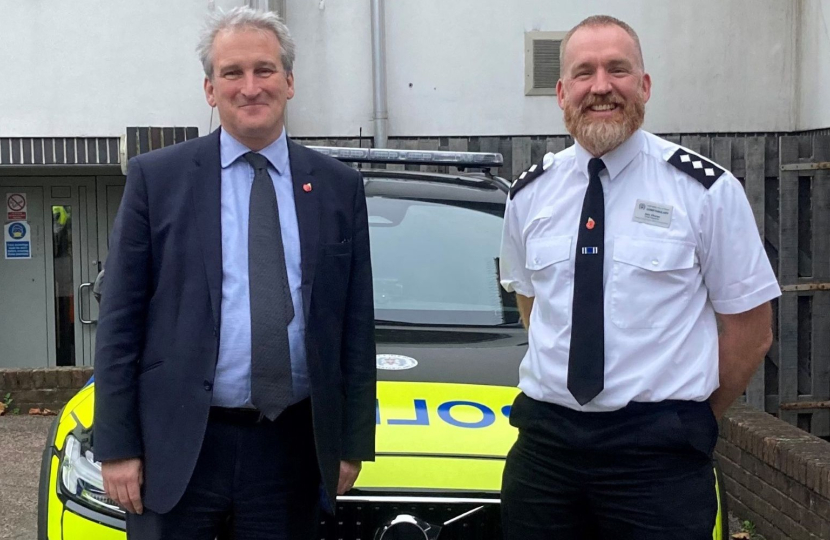
Damian is pictured above with Alex Charge, the former district commander for East Hampshire.