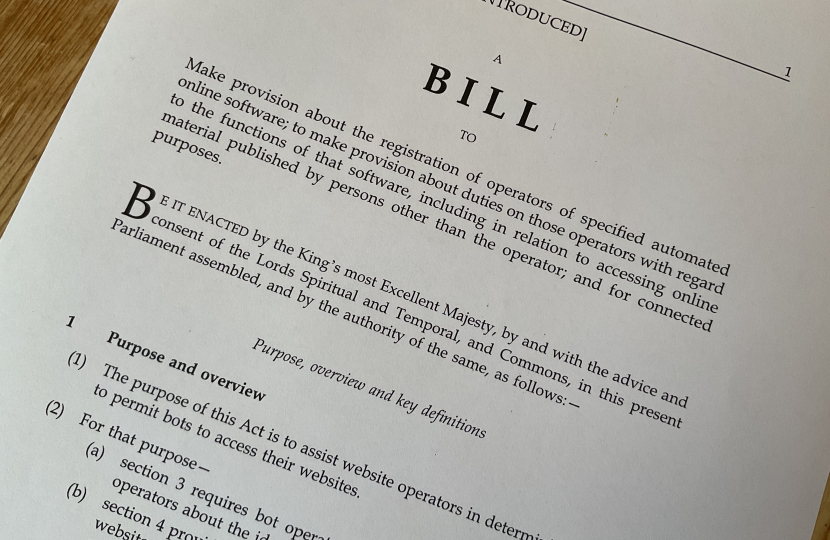
My Private Member’s Bill – the ‘Stealth Bots’ Bill, or more formally the ‘Automated Online Software (Access and Transparency)’ Bill – was not reached for Second Reading, due to some ‘extended debate’ on an earlier Bill.
But I think the Bill would do something important – for both news media and other sectors – and I hope that through another MP on another day it will be possible to bring the subject back to the House – or perhaps the government will decide to adopt the principles in one of its own Bills. There is also a similar Bill being proposed in the US Congress.
The Bill text is here:
https://publications.parliament.uk/pa/bills/cbill/59-02/0025/260025.pdf
Here is what I had planned to say on Friday:
I beg to move, that the Bill be now read a second time.
The Bill does one simple thing.
If you send an automated robotic software agent – a bot – on to somebody else’s website to copy their content, you would have to say who you are and what you want it for.
I am deeply indebted to the work of the parliamentary draftsmen, the Public Bill Office and others for their support in getting this Bill in front of the House today.
It is not necessarily an easy thing to understand but it is an important matter and one that is also being debated on the other side of the Atlantic in the form of the Stealth Bot Prohibition Bill now before US Congress.
Appropriate that we should be looking at this in parallel, since while the Internet has its roots in the US Department of Defense, the worldwide web which sits atop it is a great British invention.
We have been through a few generations of terminology for users of this technology:
Web users, cybernauts, surfers, websters, digital natives, netizens, now increasingly doomscrollers.
But a great deal of what now happens on the internet is not done by people at all – it is carried out by automated online software – a ‘bot or a crawler, that visits web pages, and analyses and copies what it finds – known as scraping content. Last year, bots made up 53% of all internet traffic.
Some of this activity is benign – indeed it is how search engines like Google find content so that they can provide us with search results.
‘Honest’ bots carry a digital id, known as a ‘user agent string’ that identifies them to websites. The website can then decide whether to let it in, turn it away or ask it to pay for access.
‘Stealth bots’ are different and are designed specifically to avoid being identified.
Let me give you an example of how this works:
A bot turns up under its own name and is blocked. It comes back pretending to be Googlebot, which it knows no site can afford to turn away because that is the bot that finds content for Google’s search results. Then it pretends to be a human, scrolling down the page as you or I would. And when that fails, it comes back as hundreds of visitors (known as residential IP proxies), routed through ordinary people’s routers, smart TVs and phones without their knowledge.
With this Bill: If you send a bot on to somebody else’s website to copy their content, you have to say who you are and what you want it for. It must not pretend to be another bot, or a person.
The Bill does not regulate AI models, change copyright law, decide which bots go where, or touch members of the public using AI tools.
No new technology is needed: the internet architecture for a bot to provide a digital ID already exists. What is missing is an obligation to tell the truth.
Why is this important?
This year, scraping tools on open sale were tested against the UK’s 20 most popular news websites. 19 could be scraped, even with paywalls and expensive bot-blocking technology.
For publishers, their content will be read, but not on their own website where they can gain revenue. Large UK publishers are getting tens of millions of attempts to access their content every day.
But this is not a Bill just for one industry. Retailers, hoteliers and ticket sellers bear a great cost as well – among others.
Bots buy up concert and football tickets the moment they go on sale, they hold airline seats and hotel rooms without ever paying for them which creates a false impression of scarcity and pushes up the price. That is a cost borne by every person trying to book a holiday or go to a concert.
This is an anti-Stealth Bill but it is not an anti-innovation or anti-tech or anti-business Bill. In fact, quite the reverse.
This Bill is about one of the fundamental principles of market economics: the ability to enforce property rights so you can derive value from what you create.
If someone can come along and just take something you've made, which cost you to produce, in time people will just stop producing those things. That's a danger with quality journalism, for example, if readers never see the actual news site, so it can't make advertising revenue. It applies in different ways in multiple other sectors, too.
This will also promote competition beyond just the short term. Scrapers have been described as “products that destroy their own supply chain”. That’s obviously not in their self-interest. But no company wants to blink first and pay while competitors help themselves. Only a level playing field, set in law, solves that.
This Bill doesn't seek to ban anything, just seeks to let content owners see who is taking their content, so they can decide if they're happy with that or want to seek an agreement for access and reproduction.
How is the Bill structured?
Clause 1 and 2 set out the purpose of the Bill and provide definitions
Clause 3 asks that operators of bots ensure that whenever their bot accesses a website, it confirms it is a bot, states who operates it and how to contact them and discloses what the content will be used for.
Clause 4 lays a duty on Ofcom to hold a register of bots and bot operators. This will require a money resolution due to the cost of establishing and maintaining such a register
Clause 5 allows website operators to bring civil proceedings against bot operators who fail to comply with the duties in clause 3.
Clause 6 lays a duty on Ofcom to issue compliance notices to bot operators that have failed to comply with the duties in clause 3. This provides a route to enforcement that does not depend on a website operator bringing civil proceedings.
Clause 7 sets out the Bill’s Extra-territorial application.
This is a modest bill, that simply asks one thing of those who send bots into other people’s property: that they are honest about who they are and why they are there.
We expect that of people in almost every other walk of life, and I do not think it is too much to expect of a bot, or rather of the company that sends it.
So I ask the Minister: will the Government support this Bill into Committee? Or, if they would rather legislate themselves, will they use the forthcoming Regulating for Growth Bill?
Thank you Mr Speaker and I commend this Bill to the House.