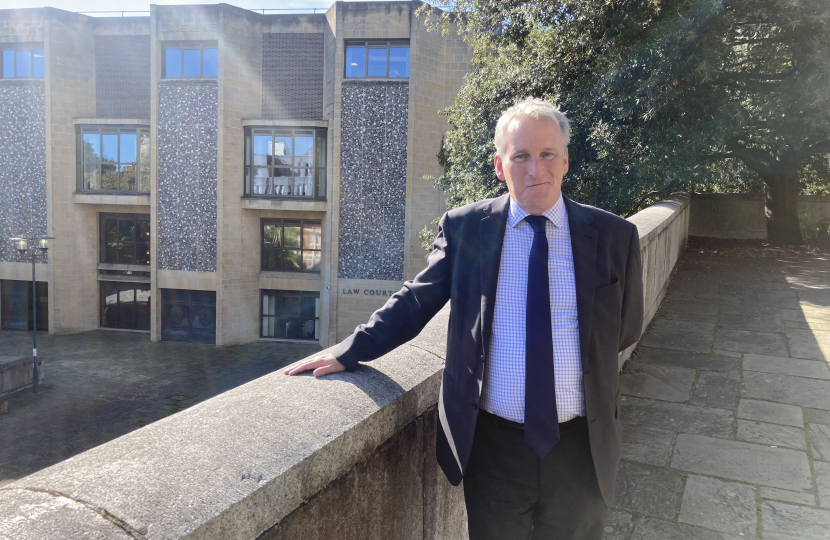
When I visited the Winchester Law Courts recently (pictured above), I was struck by how our legal institutions strike awe in those who come into contact with them. The traditions and established procedure are part of creating trust that fair outcomes will prevail.
That is not to say all is perfect in the legal system – far from it. In particular, and especially since Covid but exacerbated by the increasing complexity of digital evidence, the backlogs in the system have become too long. In his recent report, Sir Brian Leveson proposes a significant shake-up of the criminal justice system to tackle the huge backlog of cases awaiting trial.
But there are very major concerns from many – and not just people like me, but even some of the government’s own backbenchers – about what Justice Secretary David Lammy has now announced he plans to do.
The proposal in the headlines is removing the right to a jury trial for all offences carrying a maximum prison sentence of three years or less. That means cases involving, for example, certain theft, stalking, fraud, burglary and drug offences would in future be heard by a single judge, not a jury.
The long-standing right of defendants in ‘either-way’ cases to choose whether their trial is held in the Magistrates’ Court, or the Crown Court would also disappear. Instead, a judge would decide. Magistrates’ sentencing powers would expand from a maximum of one year to at least 18 months, and possibly 24 months.
I get the drive to reduce the backlog in the courts, but restricting jury trial like this is not the way to do it. Since Magna Carta, being judged by a jury of one’s peers has been a cornerstone of our justice system.
Many, including some of the Justice Secretary’s own MPs, fear that vulnerable defendants or those from certain groups could be judged more harshly by a single individual than by a diverse group of ordinary people, drawn at random from the citizenry.
The Separation of Powers is clear – that the judiciary is separate from and independent from the executive (the government) and the legislature (Parliament). I know from my time at the Ministry of Justice that this separation is fiercely, and rightly, defended.
But all branches of the constitution rely on public trust. I do worry that this move could erode public trust in the criminal justice system, at a time when trust in our institutions is under more strain.
Legal professionals have expressed misgivings. In its Monday Message last week, the Criminal Bar Association quotes Winston Churchill: “The jury system has come to stand for all we mean by English justice. The scrutiny of 12 honest jurors provides defendants and plaintiffs alike a safeguard from arbitrary perversion of the law.”
There is also a practical question: will this actually fix the backlog? Given the relatively small number of jury trials overall, critics argue the impact will be less than imagined.
It is estimated that up to 20% of courtrooms sit unused, even as cases pile up. Would it not make more sense first to run courts at full capacity - longer days, more sitting days? After all, crime does not pause because the courts are closed.