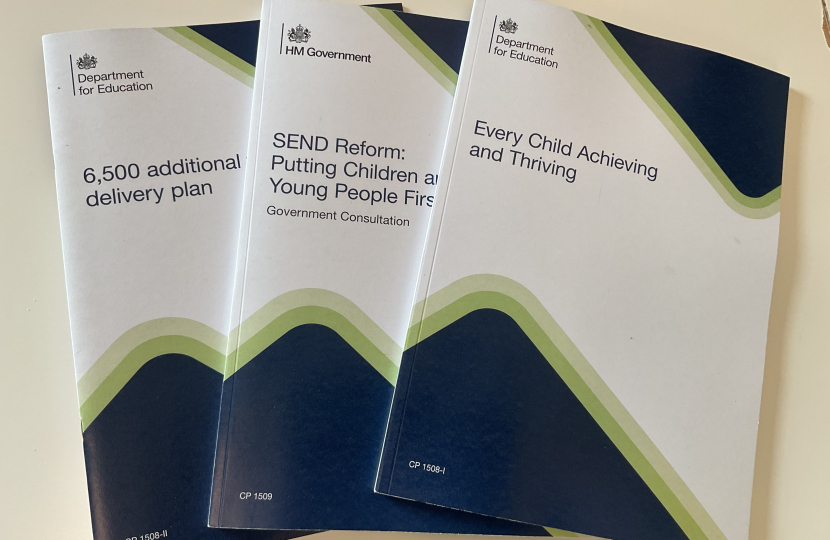
It was a long time in the coming. You might expect a Schools White Paper to be published in the first few months after a change of government; this one has taken a year and a half.
Some of what is proposed is sensible.
Stating that school Trusts will be at the heart of the system brings some helpful clarity for the sector, although it is at odds somewhat with other government legislation that takes away some of what makes Trusts successful.
An ambition to halve the ‘attainment gap’ for disadvantaged children is certainly welcome – and continues the focus we had in government. But it’s reasonable to have questions when a government simultaneously says it is going to change quite significantly how that gap is measured.
Of course educational challenges are greater in some places than others, and the school funding formula has long allocated more money towards poorer areas. But the government is now saying it intends further to ‘target’ deprivation funding. I worry about what that might mean for areas like East Hampshire and I have tabled questions to ministers to seek more information.
The big focus has been on the provisions for children with Special Educational Needs or a Disability (SEND).
Families with children with additional needs often make huge sacrifices to secure the best for them, and too often can feel embattled in the process.
My first surgery case in May 2010 was with a family struggling to get a Statement (the system that preceded Education Health & Care Plans, or EHCPs) for their child.
Reforms in 2014 brought in EHCPs, seeking to bring together Health and Care with Education, and extending the age range. The number of EHCPs has grown dramatically – by 80% nationally since 2018, and by even more in Hampshire.
Some of this growth is about greater awareness and diagnosis but there is also a factor of increased underlying prevalence of conditions.
There have been big worries among families that support for children could be reduced. In what the government have now published they say changes will be gradual, with changes in existing EHCP support only from 2030.
As it would apply only when you change ‘phase’ of education (e.g. from primary to secondary), as I understand it that should mean a child in Hampshire currently aged eight or older should retain their EHCP at least until age 16.
Indeed the government projects that up to 2030, the number of children with an EHCP will still grow significantly. After that, they say the number should come down to below current levels.
In the system that will be put in place there will be more emphasis on ‘Individual Support Plans’ (ISPs) in schools, with a ‘Targeted’ and a ‘Targeted Plus’ tier. The DfE says it will back this with funding.
EHCPs would be retained for the ISP tier of most acute needs called ‘Specialist’. Children in this group will have a ‘Specialist Provision Package’ and EHCP as well as the ISP which will detail the day to day support they receive. I have an inkling that it will be the distinction and interaction between these three elements where much of the debate will be.
These are significant changes, and warrant considerable scrutiny.
The Department for Education’s consultation is open to mid-May and can be accessed here: https://www.gov.uk/government/consultations/send-reform-putting-children-and-young-people-first.