One of the biggest demographic changes of recent years has received surprisingly little attention, yet it is likely to shape many areas of policy in the years ahead.
I’m talking about falling birth rates.
In developed countries, the ‘replacement rate’ – the average number of children each woman would have if the population were to ‘replace’ itself in the long term, without migration and ignoring rising longevity – is 2.1. (One might reasonably suppose it would be 2.0 – the difference comes because more boys are born than girls).
At the peak of the baby boom years, the UK number was close to 3; through the 1980s, 1990s and 2000s it was mostly between 1.7 and 1.9. Now the most recent figure has dropped to just below 1.4.
This is not simply a British phenomenon. Countries like Italy have long worried about a lower birth rate. China famously had a ‘1-child policy’ but years ago that became a 2-child limit, then briefly a 3-child limit, then they removed all limits; but the actual average birth rate carried on falling.
Birth rate changes and population changes are not the same thing (because of rising life expectancy and in individual countries, including ours, net migration) but across much of the world, population growth is also slowing. The United Nations now expects the global population to peak later this century before beginning a gradual decline.
For as long as I can remember, commentators have worried about the effects of a rapidly growing world population. It is ironic that now many of them worry about the opposite issue.
Back to Britain. One obvious policy area the birth rate is relevant to is housing.
The first impact would be not so much the total number of homes required, but the type of housing needed. If average family sizes become smaller, the mix of homes required changes. I recently asked ministers whether they’d be updating guidance for local authorities.
Perhaps the most immediate effect, however, is on schools. This is an issue I have also been raising with ministers because in rural areas such as East Hampshire, a village school can feel the effects of changes in pupil numbers particularly sharply.
Around 92% of school funding is based on pupil numbers, yet many of a school's costs are fixed regardless of how many children are on the roll. Department for Education forecasts suggest Hampshire's primary school population could fall by around 3.5% by 2028-29.
These changes will not affect every area in the same way. New housing developments may increase demand in some areas, while others experience falling numbers. That is why I have argued for a better funding formula for rural schools.
In time, the implications of the falling birth rate could extend much further. Fewer births today mean fewer people of working age tomorrow, with important consequences for economic growth, how pensions and health and social care are funded, and the balance between generations. But that is too big a subject to also fit into this column – one for another day.
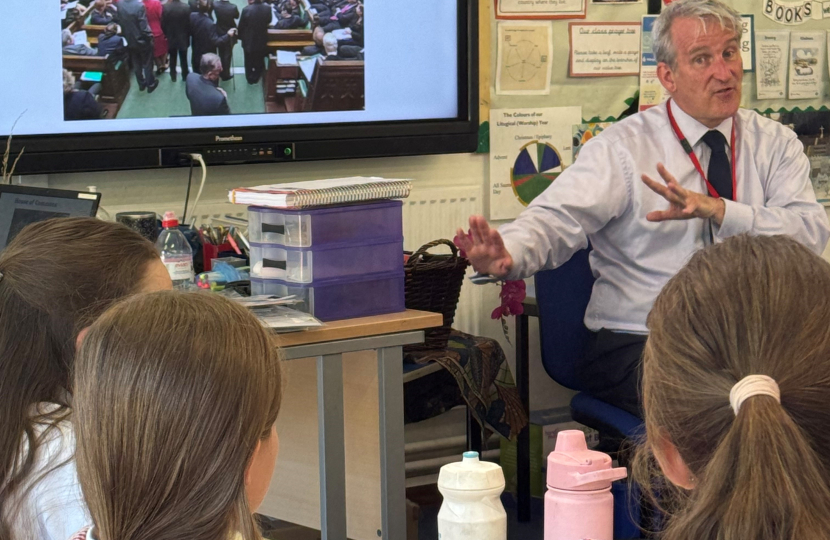
Damian is pictured above at Preston Candover School.